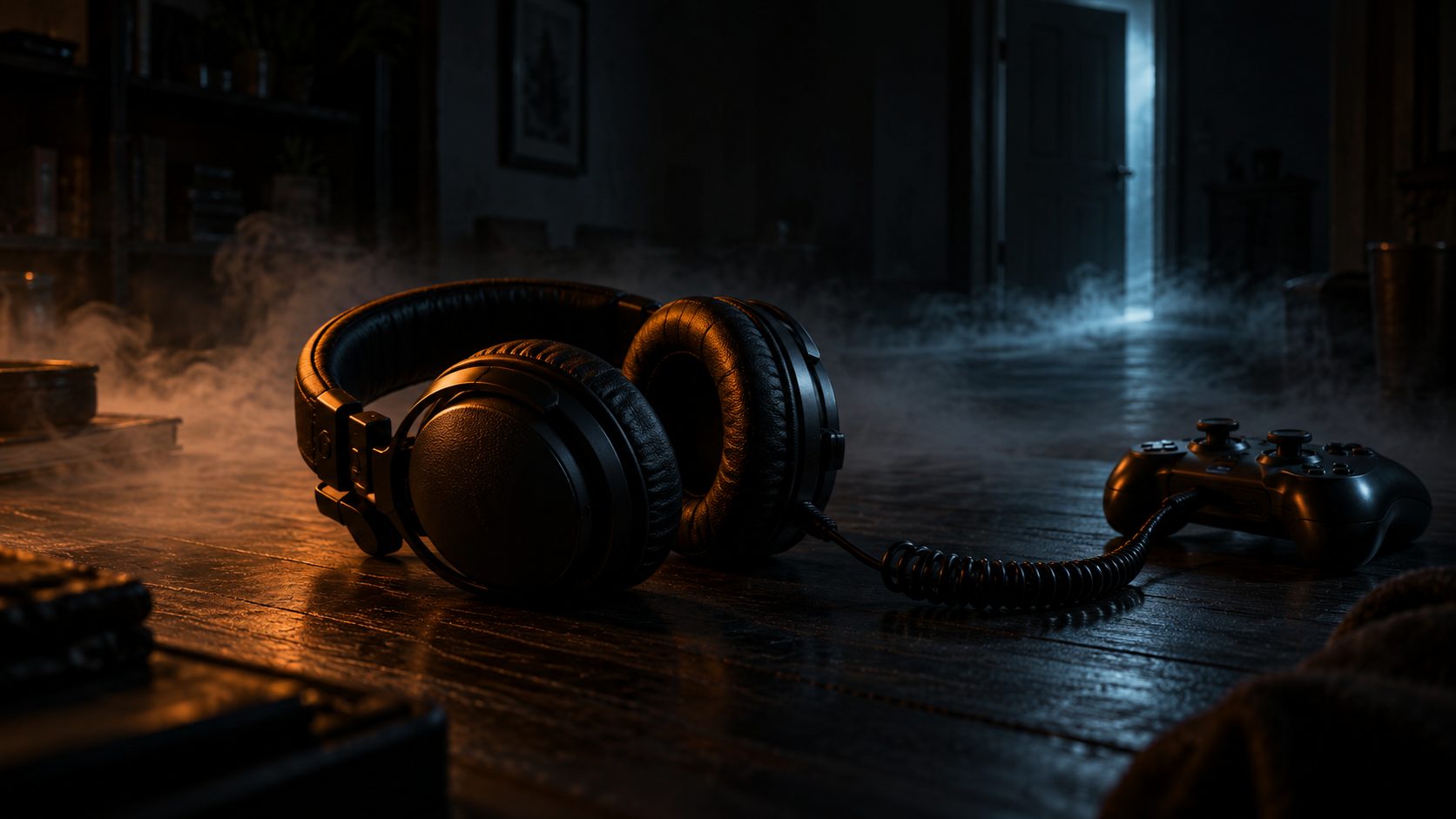
For horror games, buy closed-back headphones — the kind with sealed ear cups that block out the room — and check that they connect to your platform. Horror hides its scares in sound: a creak behind you, breathing in the next room, a whisper from one side. Sealed cups and a quiet, dark room let you hear all of it. We picked three that fit different budgets: the Audio-Technica ATH-M40x (about $100, wired), the SteelSeries Arctis Nova Pro Wireless (about $299, noise-cancelling), and the Audeze Maxwell 2 (about $329–349, the most detailed sound).
Why Do Headphones Make Horror Games Scarier?
Because horror games put the danger in the audio. Most of the fear comes from things you can’t see yet — footsteps behind you, a door creaking, a voice that seems to come from the left. Headphones play each sound directly into one ear or the other, so you can tell where it came from, and sealed ear cups shut out the room so quiet sounds don’t get lost. Speakers can’t do both: they blend the game with whatever else is happening in your living room.
What Should You Look For in Headphones for Horror Games?
- A tight seal. Closed-back headphones (sealed ear cups that keep outside noise out and the game’s sound in) block more of the room than open-back ones (vented cups that sound more spacious but let the room leak in). Active noise cancellation, or ANC — built-in microphones that cancel steady background noise like fans — goes a step further.
- Directional sound. Spatial audio is processing that makes two ear cups feel like a 3D space, so you can tell a sound is above, behind or beside you. PS5 has it built in: Sony’s Tempest 3D AudioTech is designed to work with stereo headphones plugged into the controller or connected over USB. Xbox and PC offer options such as Windows Sonic (built in) and Dolby Atmos for Headphones (which may need a separate purchase).
- A microphone, only if you play co-op. In Phasmophobia, a co-op ghost-hunting game, you talk to ghosts out loud, and the developer added voice recognition for PS5 and Xbox Series X|S. On PS5 the DualSense controller’s built-in mic works; on Xbox you need a headset plugged into the controller or a wireless Xbox headset. Single-player horror needs no mic at all.
Will My Headphones Work on PS5, Xbox, and PC?
Not always. Regular Bluetooth headphones, including AirPods, don’t connect directly to a PS5 or an Xbox Series X|S — both consoles skip Bluetooth audio. Here’s what works instead:
| Platform | Bluetooth headphones | What works instead |
|---|---|---|
| PC | Yes | Almost anything: wired, Bluetooth, or a headset with a USB or 2.4GHz dongle |
| PS5 | No (not natively) | Wired into the DualSense controller’s 3.5mm jack, a headset with a USB dongle, or a third-party Bluetooth adapter (Sony doesn’t guarantee these) |
| Xbox Series X|S | No | Wired into the controller’s 3.5mm jack, or a headset that uses Xbox Wireless |
That’s why one of our picks is wired: it works the same way on all three. For a deeper look at connection types, see our gaming headset buying guide.
Our 3 Picks for Horror Games
If you want the best sound for the money: Audio-Technica ATH-M40x
These are closed-back studio headphones with a detachable cable. Plug them into a PC, a PS5 controller or an Xbox controller and they just work — no dongle, no battery, no wireless delay. The sealed cups keep the room out, which is most of what horror needs.
- Design: closed-back, 40mm drivers, 35 ohm impedance (easy to power from a controller)
- Frequency response: 15–24,000 Hz
- Cables: two detachable cables included (one coiled, one straight)
- Microphone: none
- Price: around $100
Who it’s for: anyone who wants good, sealed sound on any platform without spending much. Who should skip it: anyone who wants wireless, or a built-in mic for co-op games — you’d need the PS5 controller’s mic or a separate microphone.
Our budget pick: sealed cups and a simple wired connection that works on everything.
Check Price on Amazon (coming soon)If you want to shut out the room completely: SteelSeries Arctis Nova Pro Wireless
It’s the one headset in our best gaming headsets roundup with real active noise cancellation, so a noisy house, a party downstairs or a loud PC fan fades into the background. A transparency mode lets the room back in when you need to hear someone at the door. For more on how ANC works, see our best noise-cancelling headphones guide.
- ANC: active noise cancellation with transparency mode
- Battery: two hot-swappable batteries, up to 22 hours each
- Spatial audio: PS5 Tempest 3D AudioTech compatible
- Platforms: PC, PS5, PS4, Switch, mobile
- Price: around $299
Who it’s for: players in a busy home who want a mic, wireless freedom and a seal tight enough to disappear into the game. Who should skip it: Xbox players (the standard version isn’t built for Xbox Wireless) and anyone on a tighter budget.
Our pick for blocking out the room: real noise cancellation in a wireless gaming headset.
Check Price on Amazon (coming soon)If you want the most detailed sound: Audeze Maxwell 2
Planar magnetic drivers — a different, flat-panel driver design best known for detail and low distortion — are the best bet for catching the faintest sounds in a quiet scene: a distant footstep, a breath, a floorboard. Audeze brings that design into a gaming headset.
- Drivers: 90mm planar magnetic, 10Hz–50,000Hz frequency response
- Battery: over 80 hours wireless
- Connectivity: 2.4GHz wireless (USB-C dongle), Bluetooth 5.3, USB-C, 3.5mm analog
- Microphone: detachable boom mic
- Platforms: PC, PlayStation, Mac, Switch
- Price: around $329–349
Who it’s for: players who want to catch every small detail, and who’ll also use the headset for music and movies. Who should skip it: Xbox players looking for native wireless support, and anyone who doesn’t want to spend over $300.
Our pick for detail: planar magnetic drivers for the quietest, creepiest sounds.
Check Price on Amazon (coming soon)Want something between $100 and $300? The HyperX Cloud III Wireless (around $170) is our value pick in the same gaming headsets roundup.
How Do You Set Up Headphones for the Scariest Sound?
- Turn on your platform’s 3D audio: the 3D Audio option in PS5’s sound settings, or Windows Sonic on Xbox and PC.
- Open the game’s own audio menu and pick a headphones or stereo option if it offers one — many games do.
- Play with the lights off and the TV, fans and other noise turned down, so quiet sounds can be heard.
- Start with the volume low. Jump scares are sudden and loud, and loud sound can hurt your hearing.
How We Selected These
We selected these headphones based on manufacturer specifications, retailer listings, platform documentation (including Sony’s PS5 support pages and the Phasmophobia developer’s update notes), and the research behind our gaming headset roundup, with US pricing as of October 2026 rounded to ranges. We have not physically tested these products ourselves. Prices change often, and we’ll update this guide as new models launch.
Horror Game Headphones FAQ
Do I need a 7.1 surround headset for horror games?
Usually not. Most “7.1 surround” headsets create the effect with software, and a good pair of stereo ear cups plus your platform’s spatial audio (PS5’s 3D Audio, Windows Sonic) does the same job. Seal and sound quality matter more than the surround label.
Are open-back headphones better for horror games?
Open-back headphones can sound more spacious, but they let room noise in and your game’s sound out. For most people — shared homes, a console in the living room — closed-back is the safer choice for horror. If you game alone in a silent room, open-back is worth a look.
Can I use AirPods or other Bluetooth headphones?
On a PC, yes. On PS5 and Xbox Series X|S, not directly — you’d need a wired connection through the controller, a headset with its own dongle, or (on PS5) a third-party Bluetooth adapter. Our guide to choosing wireless headphones explains how Bluetooth, dongles and latency differ.
Final Thoughts
You don’t need to spend a fortune to be properly scared: sealed ear cups, a connection that works with your platform and a dark, quiet room do most of the work. Start with the ATH-M40x if you’re not sure, and step up to noise cancellation or planar drivers if you want every last whisper. Decorating for Halloween too? See our guide to smart Halloween decorations.
This site may contain affiliate links to Amazon.com. See our Affiliate Disclaimer for details.